
The 60-Day Exposure Test: 7 Online Business Models Ranked By How Much Of Your Own Face, Time And Money They Actually Cost

Are You Tired Of Online Business Models That Only Pay You If You Are Willing To Put Your Own Face On Camera Every Single Day?
If you have already tried dropshipping, Amazon FBA, an agency, Etsy, print on demand or affiliate marketing, you know how the story goes.
The money always seems to sit one step behind something you do not have. More ad budget. More product cost. More client calls. Or the one most people never admit to, more time in front of a camera.
The base rates on the popular models are not a secret. Around 9 in 10 new Amazon FBA sellers fail. Only about 1 in 10 dropshippers make it through their first year. Roughly 65% of print on demand stores close inside twelve months. And in our own 60 day test, the models that paid fastest were also the ones that demanded the most of the operator's own face, calls and calendar before the first sale landed.
That is the hidden price of most online businesses. Not the software. Not the ad spend. You.
So we set out to answer one question: which online model produces income with the least personal exposure, the least upfront cost, and an asset you actually own at the end of it?
Over 60 days we tested 7 of the most widely sold online business models, tracking every hour and every dollar. Here is what we measured.
- Personal Exposure Cost: How many hours does the model demand in front of a camera, on calls, or in DMs before the first sale? Can it run without your face, your name, or your voice?
- Cost To First Live Asset: What does it actually take in cash and days to get one thing live that can make money? Software, inventory, ad budget, everything counted.
- Ownership And Transferability: At the end of 60 days, do you own something with value that keeps working, or did you only rent access to someone else's platform, audience or supplier?
The models that scored highest all shared one trait. The thing that earns is separate from the person who built it. A persona, a page, a product, a system. It does not need you awake to keep working.
A model that only earns while you are performing is a job with extra steps, and it is the first thing to break the week life gets busy.
Every top scoring model in the test had a defined way to produce the next unit of work, the next post, the next asset, the next listing, without starting from a blank page.
That is what separates a week where you publish nine times from a week where you stare at a screen and publish nothing.
Some models require you to buy every visitor. Others earn attention for free and only pay for it once the offer is proven. That single difference decided most of our rankings.
Paid distribution is not a problem in itself. Depending on paid distribution before you have proof is.
The models that survived our 60 days all had at least one repetitive task handled by software rather than willpower: image generation, scheduling, fulfilment or replies.
Nothing kills a side business faster than the part you dread doing every night at 9pm.
When you get stuck at 11pm on a Tuesday, the difference between quitting and finishing is one answered question. Look for direct support, not a ticket queue.
Some people work better with peers around them. Others lose entire evenings to group chats. Either is fine, as long as it is your choice and not a requirement of the model.
This niche moves month to month. Whatever you buy should be updated as the tools change, or you will be running last year's process by autumn.
A screenshot proves someone had a good day. It proves nothing about whether the process repeats for you. Look for process detail instead.
Some models are cheap to start and expensive to run. Ad budget, product cost, subscriptions and fees are all part of the price. Add them up before you commit.
If the only fix offered when things stall is more of your own personal exposure, the model itself was never the asset. You were.
The 60-Day Exposure Test: 7 Models Ranked
AI Influencer Portfolio (Content DFY): Lowest Exposure, Fastest To Live
PROS:
- Requires no camera, no personal brand and no voice on video
- Entry cost is $27, the lowest of every model in the test
- The persona is built for you, so the face is locked and consistent before you post anything
- Content production is systemised, so the next post is never a blank page
- Free organic distribution first, paid traffic only once something is proven
- Direct support rather than a ticket queue
- Backed by a 180 day money back guarantee, the longest in the test
- The account and persona remain yours and can be handed over or sold
CONS:
- Only sold through the official Content DFY site, not on course marketplaces
- The build gets the persona live for you, but growing the account still depends on you publishing consistently for the first few weeks
Why The AI Influencer Model Finished First
It was not the flashiest thing we tested. It was the only model that scored well on all three of our measures at once.
Every other model forced a trade. The fast ones demanded personal exposure. The private ones demanded real money upfront. This one asked for $27 and an afternoon, and what came out the other side was an asset that kept publishing without a camera ever being switched on.
It also solved the problem that kills most do it yourself attempts at this model. If you have ever tried to make an AI persona and watched her face change between posts, that was not the tools failing. It was the persona being regenerated from scratch every time instead of locked once and reused. Here the identity is built and locked before you touch it, which is the single hardest part of the whole model handled on day one.
What Is Inside
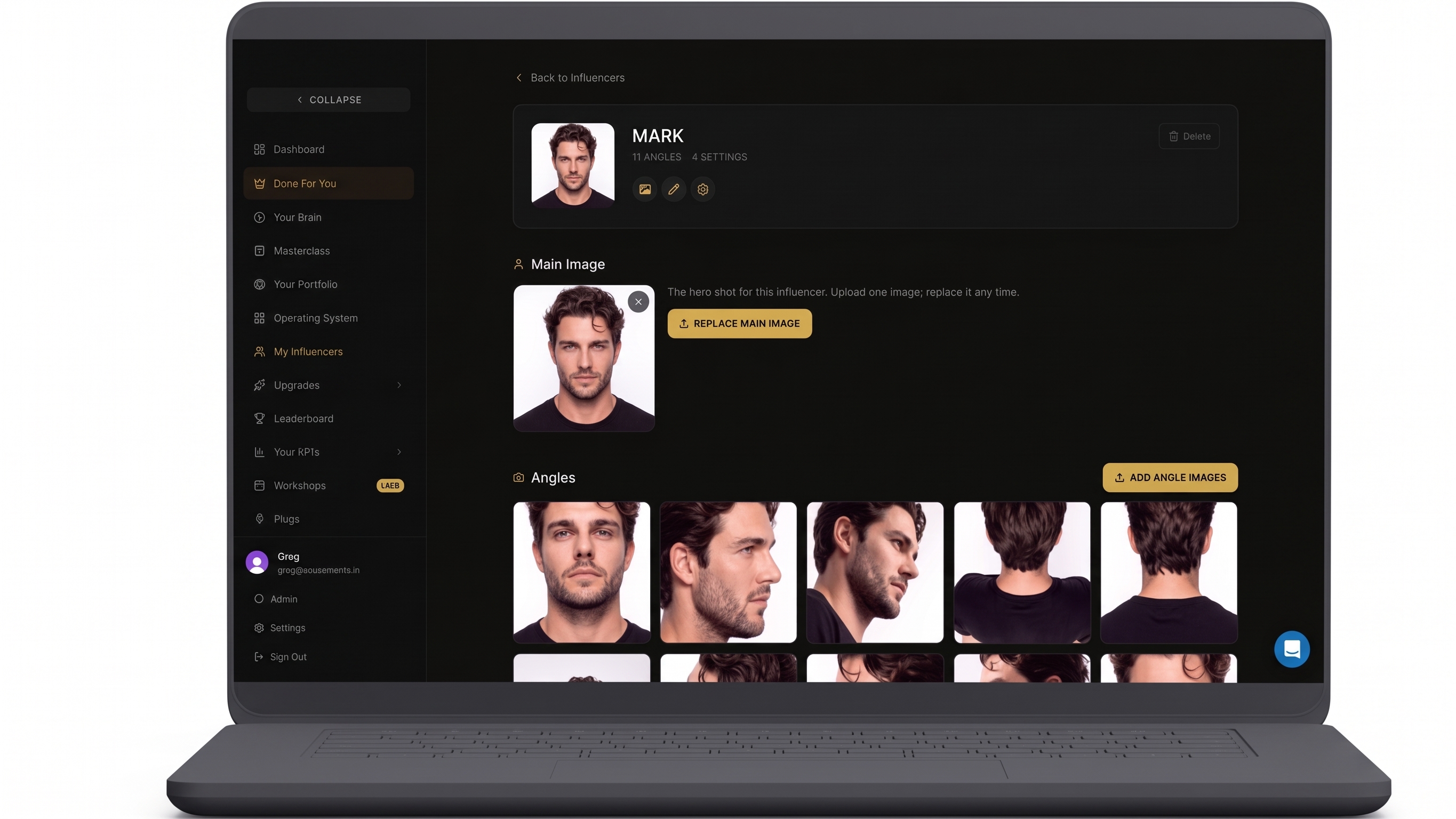
The AI Influencer Portfolio is a done for you build plus a masterclass, organised in the order the work actually happens:
- A locked persona, built for you: A named AI influencer with a niche, a look and a consistent face, delivered ready to post rather than left for you to prompt into existence.
- The content system: The repeatable process for generating images and short video for the persona, including the prompt structures that keep the face consistent across every post.
- Posting and growth: What to publish, how often, and the early signals that tell you a persona is working before any money changes hands.
- Four monetisation routes: Brand and UGC content work, affiliate offers, your own digital products and paid fan platforms, with guidance on which fits a faceless account and which does not.
- Direct support: Questions get answered by the team that runs the system, not a moderator.
Why It Works So Well
The mechanism is simple. Attention is the expensive part of every online business, and this model produces attention without requiring the operator to be the product.
That removes the three things that kill most side businesses in the first month:
- No camera, so no daily performance and no reason to postpone publishing
- No inventory, no suppliers and no refunds to process
- No clients, no calls and no scope creep
It is also the only model in our test where the operator stays fully separate from the asset. The persona has its own name, the account runs under a brand rather than a person, and there is no founder story attached to any of it. The AI nature of the persona is disclosed, the operator behind it is not. For anyone with an employment contract or a professional reputation to protect, that separation is not a small detail.
No Community Noise, Just The Process
There is no forum to keep up with and no group chat to perform in. The material is organised in order, and the next step is always visible.
For a model that lives or dies on publishing consistently, removing that distraction matters more than it sounds.
Is It Legitimate?

Yes. AI personas are disclosed as AI, the content is generated with commercially available tools, and the accounts are built on normal platform terms rather than automation tricks. Content DFY has sold over 22,000 copies of the portfolio and backs every one with a 180 day money back guarantee.
There is nothing in the process that depends on hiding what the account is.
UPDATE: The AI Influencer Portfolio is currently $27 with the full masterclass and a 180 day money back guarantee included. No coupon code needed.Authority Hacker (Affiliate And SEO Sites): Best Faceless Runner Up
PROS:
- Genuinely faceless, nothing requires you on camera
- Detailed training on site structure, content and affiliate monetisation
- The asset produced is a real property you own and can sell
CONS:
- Timelines are measured in months, not days, because search rankings take time
- Upfront cost is materially higher than the AI influencer route
Authority Hacker was the strongest of the traditional faceless models. The training is thorough and the end result is a genuine asset.
The problem is time to first result. Search based models need months of published content before traffic arrives, and that gap is where most beginners quit. It scored second on exposure and second to last on speed.
Printify And Print On Demand: Simple To Start, Thin To Scale
PROS:
- Free to start and genuinely beginner friendly
- No inventory and no fulfilment to manage
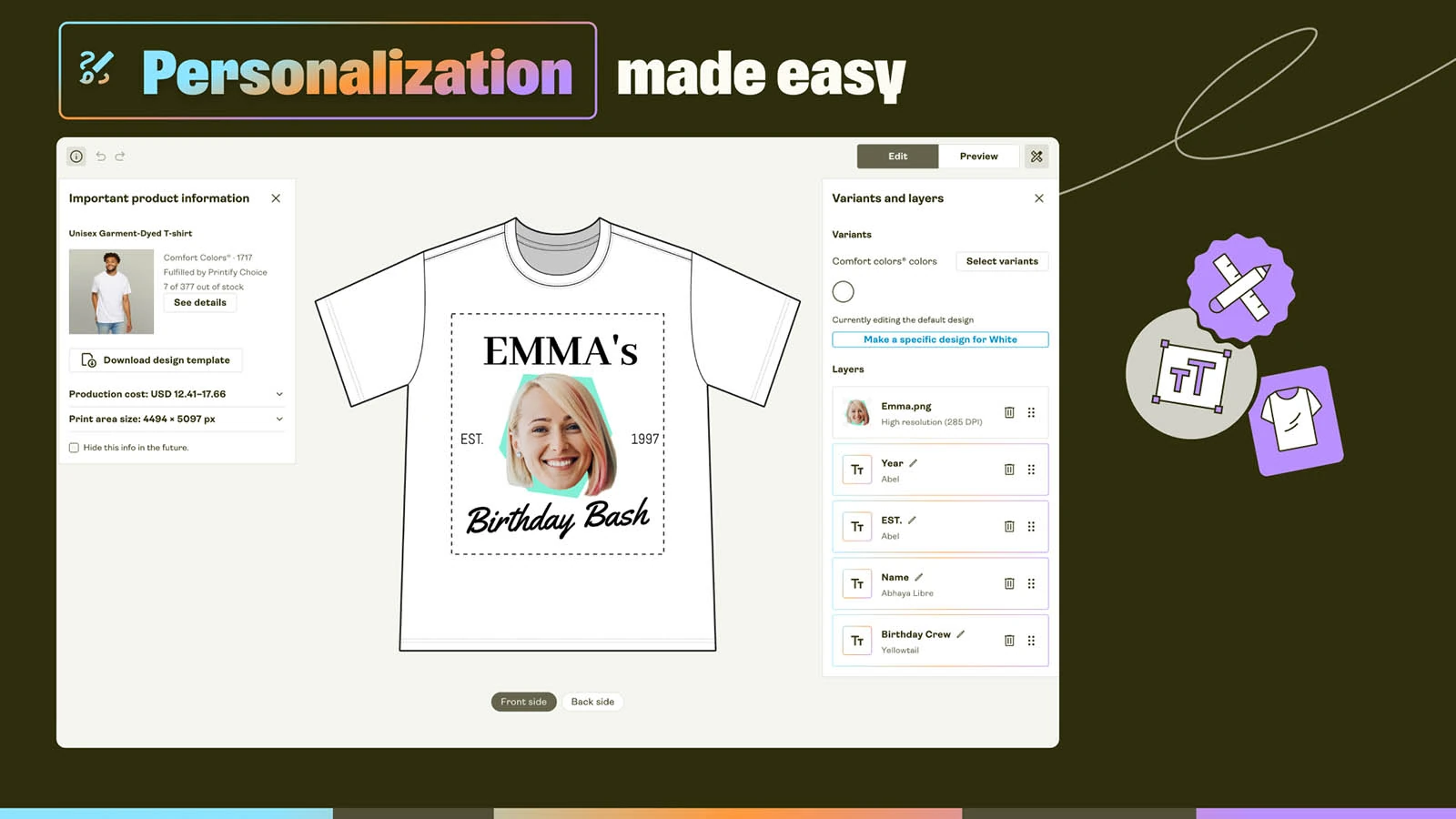
- Designs can be produced with AI tools
CONS:
- Margins per sale are small, so volume has to be high
- Traffic almost always has to be bought or driven from a social account
Print on demand is easy to begin and hard to grow. The mechanics work and nothing here requires a camera, which is why it placed mid table.
What held it back was the margin. Once product cost, platform fees and ads are subtracted, the remaining profit per sale gives very little room to buy traffic, so most operators end up needing an audience anyway.
Zendrop And Dropshipping: Reliable Tooling, Rented Everything
PROS:
- Product sourcing and fulfilment are handled by the platform
- Clear tooling and a genuinely beginner friendly interface
- Can move quickly once a winning product is found
CONS:
- Requires real ad budget before any proof exists
- Supplier and shipping issues become your customer service problem
Zendrop's tooling is good and the platform removes most of the operational pain of dropshipping.
The model itself is what cost it points. You are paying for every visitor from day one, and the asset created belongs to a supplier chain and an ad platform rather than to you. When ad costs move, the whole thing moves with them.
Imperium Agency Program (SMMA): Highest Ceiling, Highest Exposure
PROS:
- Very detailed training covering acquisition, delivery and scaling
- Cash per client is far higher than any other model tested
- Can be started with almost no software cost
CONS:
- Highest personal exposure of everything we tested, sales calls are unavoidable
- Highest upfront cost of the five ranked options
The agency model produces the biggest single payments of anything on this list, and the training is comprehensive.
It also sits at the opposite end of our main measure. The model is built on outreach and calls, so there is no version of it that works without significant personal exposure. If you are comfortable selling, that is a fair trade. If you are not, it is the wrong starting point.
The Two Models We Cannot Recommend As A Starting Point
We tested 7. Two did not make the ranking, and the reasons are structural rather than a matter of quality.
Amazon FBA. Capital first, learning second. Inventory has to be bought before demand is proven, and a mistake in product selection is paid for in cash sitting in a warehouse. It is a real business model. It is a poor first one.
Paid ads led affiliate marketing. Cheap to enter and expensive to learn. The tuition fee is paid to the ad platform in the form of losing campaigns, and beginners rarely have the budget to survive the learning curve.
Neither belongs in a beginner's first 60 days.
Why We Placed The AI Influencer Model First
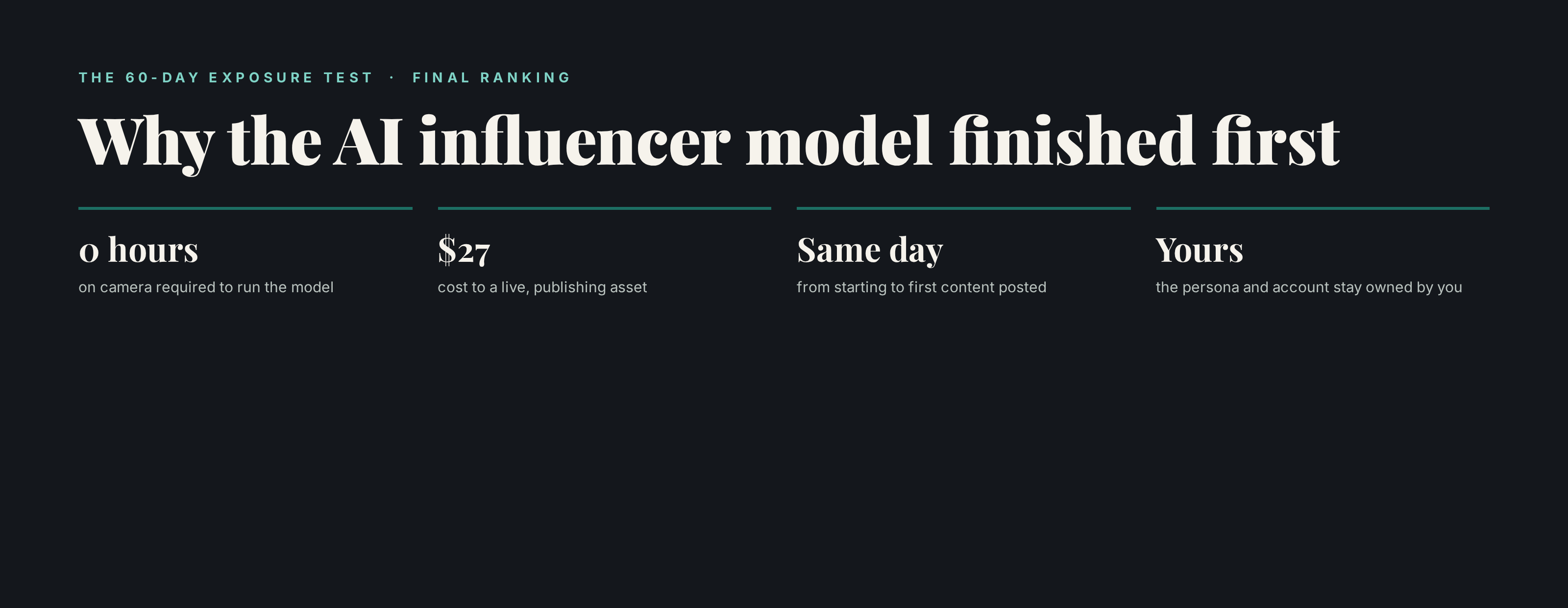
After 60 days across 7 models, one finished ahead on every measure we set out to test.
Comments

Never heard of this one before. Has anyone actually built an account with it or is this another list where number 1 is just the sponsor?

Fair question, and the disclosure at the top of the page answers the sponsor part honestly. The ranking is based on the three measures we published, and the scoring for all 7 models is in the article above. Number 1 won on exposure and cost, not on who paid.
The camera thing is what got me. I tried the agency route for four months and the calls were the reason I stopped, not the work.

Started mine about three weeks ago. Posting is the part nobody warns you about, you have to actually do it. The process for making the content is fast though, and the face has stayed the same in every post, which is more than I managed on my own.
Sceptical about the $27. Nothing that cheap is ever complete, there is always an upsell waiting.
There are optional paid add ons on the site, which we noted. The portfolio itself is standalone and does not require them to complete the process.
Print on demand was my first attempt and the margin point above is exactly right. Sold 30 shirts and made almost nothing after fees.
Been running two personas since spring. One did nothing, one worked. That ratio sounds bad until you remember it cost $27 to find out.
For me the deciding line was the bit about the operator staying separate from the account. I work somewhere with a social media clause and I am not putting my name on anything.
Tried making one of these myself last year and gave up when her face kept changing. Did not know that was a known thing until this article.